
| Sara
Carena Senior Scientist / Lecturer Structural Geology, Active Tectonics, 3D Modeling and Visualization Department of Earth and Environmental Sciences - Geology - Ludwig-Maximilians University Munich Luisenstr. 37, 80333 München, Germany Room A 133 E-Mail: sara.carena *[at]* lmu.de Phone: +49 (0) 89 2180-6574 |

|
EDUCATION RESEARCH TEACHING STUDENTS PUBLICATIONS SHORT CV |
QUICK LINKS LMU Geology LMU Main Library Faculty of Geosciences LMU Room Finder Course Catalogue GeoWiki@LMU Munich Geo Center German Aerospace Center (DLR) |
Current projects:
1)
Defining the lithospheric
structure and the kinematics of the plate boundary near Taiwan by
combining geology, earthquake data and crustal tomography. In
collaboration with John
Suppe (University of Houston), Yu-Huan Hsieh (University
of Houston), Ravi Kanda (Utah State University). DFG
project, 2018 - 2022.
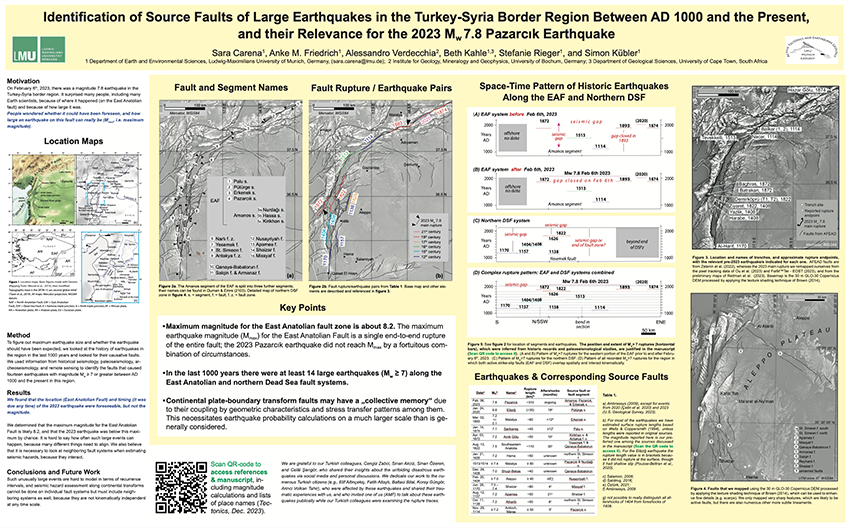
2) The
2023 Mw 7.8 Pazarcik earthquake, and large earthquakes in the past
one thousand years in the Turkey-Syria border region, in
collaboration with
3)
Long-term vertical
displacement rates of Basin and Range faults in
collaboration with Anke
Friedrich (LMU).
4) Vertical motions of the continental lithosphere, in collaboration with Anke Friedrich (LMU) and Hans-Peter Bunge (LMU).
Past projects:
1)
Determining fault
strength and crustal strength by developing finite element
models of both California and Taiwan, with Christoph Moder. The
purpose of this work was to find out what is a realistic range of
fault friction values in a transform margin setting and in a convergent
margin setting. The work is based on a coarse global grid, with local
high-resolution representation of actual faults obtained from
published 3-D fault maps. We used Aspen-SKUA (formerly SKUA-GOCAD) to do most of the grid construction and optimization (an
example can be found in this video).
By
comparing the simulation results with data on fault-slip rates, we
were able to determine how faults in the network interact, the role of
small faults, and quantify the typical fault strength in each setting. DFG project,
2006 - 2013.
2) Possible structural controls on earthquake nucleation in subduction zones, with particular focus on the south American trench.
3) Using
earthquake data in 3-D structural model building,
with Aspen-SKUA (formerly SKUA-Gocad) as the main fault model building tool. I
have modeled fault surfaces in 3-D using the aftershocks from the
1989 Loma Prieta earthquake and the 1994 Northridge
earthquake. The
aftershocks
allowed me to image in detail not only the faults that generated
these two large earthquakes, but also nearby faults. This method is
especially useful for imaging the 3-D geometry of blind thrusts, for
which there is usually little other information available.
4) Defining the geometry and kinematics of the fault network in northern Owens Valley, California, USA, and Coulomb stress history of Owens Valley and of the western Basin and Range, with Alessandro Verdecchia .
5) Postseismic
deformation of the 2013 Minab earthquake (Iran) from satellite
interferometry, in
collaboration with Stefanie Rieger, Christina
Plattner, Amir Abolghasem, Anke
Friedrich, and the German
Aerospace Center (DLR).
6) The July 2019 Ridgecrest earthquake sequence: 3D fault geometry and Coulomb stress modeling, in collaboration with Alessandro Verdecchia (Uni Bochum and McGill University) and the computational earthquake physics group of Alice-Agnes Gabriel (UCSD and LMU).
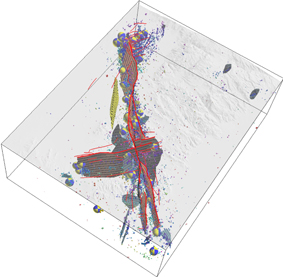
| Taufiqurrahman T., Gabriel A.-A., Li, D., Ulrich, T., Li, B., Carena, S. , Verdecchia, A., and F. Gallovic (2023) - Dynamics, interactions and delays of the 2019 Ridgecrest rupture sequence. Nature, 618, 308-315. |
My Classes for the current semester
Virtual field trips (VFT), and virtual outcrop / virtual rocks resources.
Cala del Cuervo, Spain by Sara Carena on Sketchfab
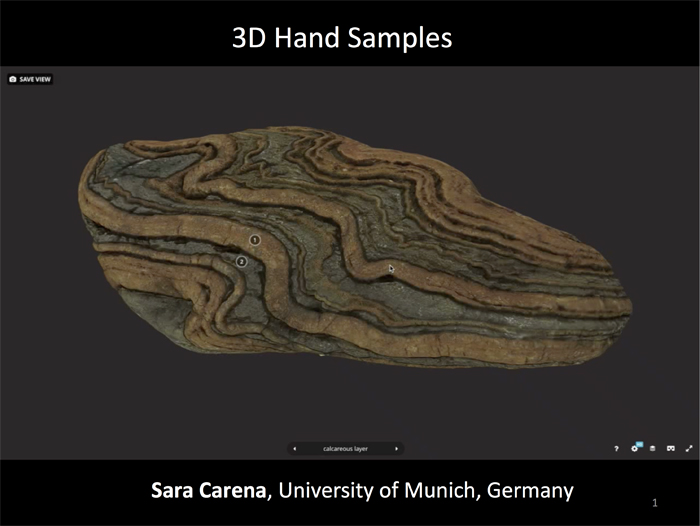
Webinar "Creating 3D Hand Samples" (August 10, 2020). Webinar hosted by the National Association of Geoscience Teachers (NAGT). After clicking on this link, scroll down to find the video.
Short presentation from the "Tag für gute Lehre" at LMU in the context of the 2021 LMU Lehrinnovationspreis.